Subura
Quo VadisThe Subura is one of the novel’s most revealing urban settings: a district of crowded housing, food insecurity, and precarious livelihoods that lies close to the routes taken by fugitives, plotters, and crowds. Before the Great Fire of Rome, it is associated with the city’s poor and its weekly grain distribution; after the disaster, its residents and alleys form part of a wider landscape of displacement, hunger, and disorder. Its recurring appearances connect individual actions to the material conditions of Rome’s urban life.
Setting and Social Conditions
The district appears among the places where Rome’s poor spend their days and nights. People who apply for grain each week at the Tiber storehouses pass their nights in fragile dwellings beyond the river and their days under porticoes or in inexpensive eating-houses in the Subura. They also gather near the Milvian Bridge and outside the residences of the wealthy, where food left over from slaves’ tables may be thrown out. This portrait situates the district within an economy of dependence: grain, shelter, and scraps of food are not incidental details but conditions shaping daily survival.
The Subura is part of a city whose population includes people from across the empire and beyond. The crowds in the Forum include enslaved people, free visitors drawn by opportunity, religious figures, traders, and those with no settled occupation. The district’s association with poor lodging and food places it within this expansive, unequal urban world, rather than apart from it. When the city’s systems fail, the residents already living close to the edge are especially exposed.
Refuge, Flight, and Pursuit
The Subura is a destination in the escape that frees Lygia from the escort transporting her. After Ursus intervenes, he carries her away to the district, while the surviving members of the escort disperse. The location thus becomes a brief refuge in the immediate aftermath of the attack, although the evidence does not establish that it remains her long-term hiding place.
Ursus’s connection to the district also reflects his network among Rome’s lower-status residents. He believes he can assemble Christians and other acquaintances from among slaves, gladiators, and free people in the Subura and beyond the bridges, imagining that a force of thousands could help rescue Lygia and carry her beyond the city. His plan is an expression of hope and determination, not a rescue operation shown to take place as described. The Subura matters here as a place where personal loyalty might be converted into collective action.
Vinicius later searches the district during a night of angry, fruitless pursuit. After leaving home with a group of servants, he goes through the Esquiline, the Subura, Vicus Sceleratus, and adjoining alleys, then continues across the city. He has little real expectation of finding Lygia; the search instead gives his agitation an outlet. His return at daybreak does not resolve the pursuit. He orders the body of Gulo put away and sends the enslaved people from whom Lygia was taken to rural prisons, while continuing to think about how to find and seize her. The Subura is therefore one of the places through which the novel traces the consequences of his possessive determination, even as Lygia has escaped him.
Networks and Schemes
The district also supplies settings and contacts for Chilo Chilonides’s opportunism. After receiving money from Vinicius, he makes his way toward the Subura to seek information through Sporus, thinking of the payment as an opening to greater profit. His reflections reveal how he views Vinicius: as an irritable but generous patron prepared to spend heavily to locate Lygia. Chilo also considers whether a further payment might let him acquire a slave and arrange a livelihood partly supported by Vinicius. The district is thus linked to his calculations about money, dependence, and access to information.
Chilo’s later efforts to arrange Glaucus’s murder draw on the precarious social world he knows from wine-shops and lodging places. He has spent nights among people without secure shelter or social protection, whom he regards as possible paid accomplices or as potential extortionists. His own repulsion from the violent figures he associates with suspected houses in the Subura and the Trans-Tiber does not make him abandon his plan; instead, he decides to approach Christians and manipulate their trust. The contrast is significant: the district represents a world Chilo considers morally dangerous, but his deception shows that his own actions are not separated from the exploitation he attributes to it.
Fire and Urban Breakdown
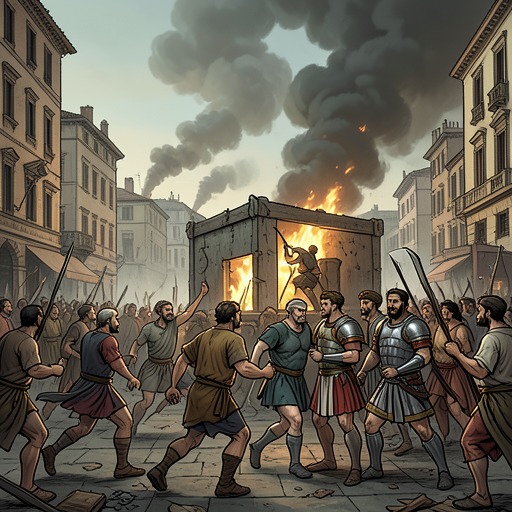
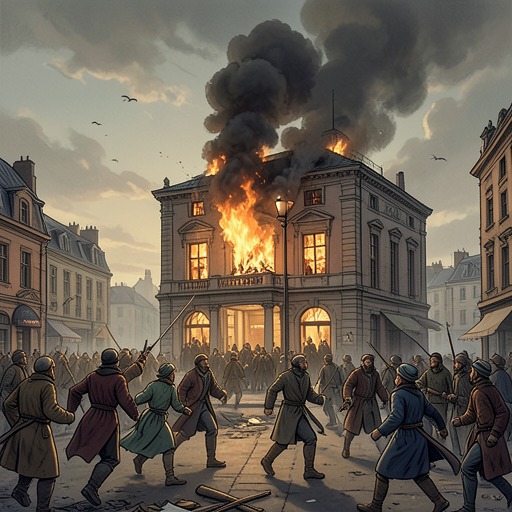
The Subura’s vulnerabilities become more consequential during the Great Fire of Rome. The novel describes the fire spreading rapidly through dense areas of shops, booths, and multi-storey houses, as well as through stores holding food and other combustible goods. The resulting destruction overwhelms the city’s ordinary means of support. Hundreds of thousands of people are displaced outside the walls, and hunger begins as the immense stores of provisions burn. These details place the Subura within the wider disaster affecting Rome’s densely populated districts and the poor who depend on city supplies.
Emergency food deliveries show how the crisis turns supply into a test of public order. When bread arrives from Ostia, a crowd breaks through the principal gate at the Emporium and seizes the provisions; people fight over loaves, some of which are trampled into the ground, and soldiers eventually disperse the crowd with missiles. The episode makes the shortage concrete: relief exists, but its arrival does not ensure that those in need can receive it peacefully. The Subura’s established association with people reliant on weekly grain makes this breakdown especially resonant, though the scene at the Emporium is not itself located in the district.
Afterward, people who had previously hidden in the Subura’s alleys and struggled with hunger are described as living more comfortably in the camps formed in Rome’s gardens and public spaces, as abundant provisions arrive and grain is sold cheaply or given to the indigent. Yet the improvement in food supply does not restore security. Robbery, murder, abductions, and nightly violence continue amid weak authority and insufficient armed control; bodies are left along the Tiber, and sickness spreads through the camps. The district’s poor are therefore presented not as a single fixed crowd but as people whose circumstances change with the crisis: the immediate threat of famine recedes, while the wider collapse of civic protection persists.
Narrative Significance
Across these episodes, the Subura links the intimate and the political. It is at once a district of inadequate shelter and food, a possible base for Ursus’s imagined rescue network, a route in Vinicius’s search, and part of the social world Chilo tries to exploit. During the fire’s aftermath, its alleys also stand for the precarious conditions from which displaced residents enter the temporary camps around Rome.
The district’s repeated presence gives material force to the novel’s contrast between imperial spectacle and ordinary survival. Rome can feed and entertain its population as a political gesture, yet the recurring dependence on grain, the scramble for emergency bread, and the persistence of violence show how fragile that provision is. The Subura is not merely a backdrop to the characters’ movements: it makes visible the urban inequalities and unstable networks through which those movements unfold.